
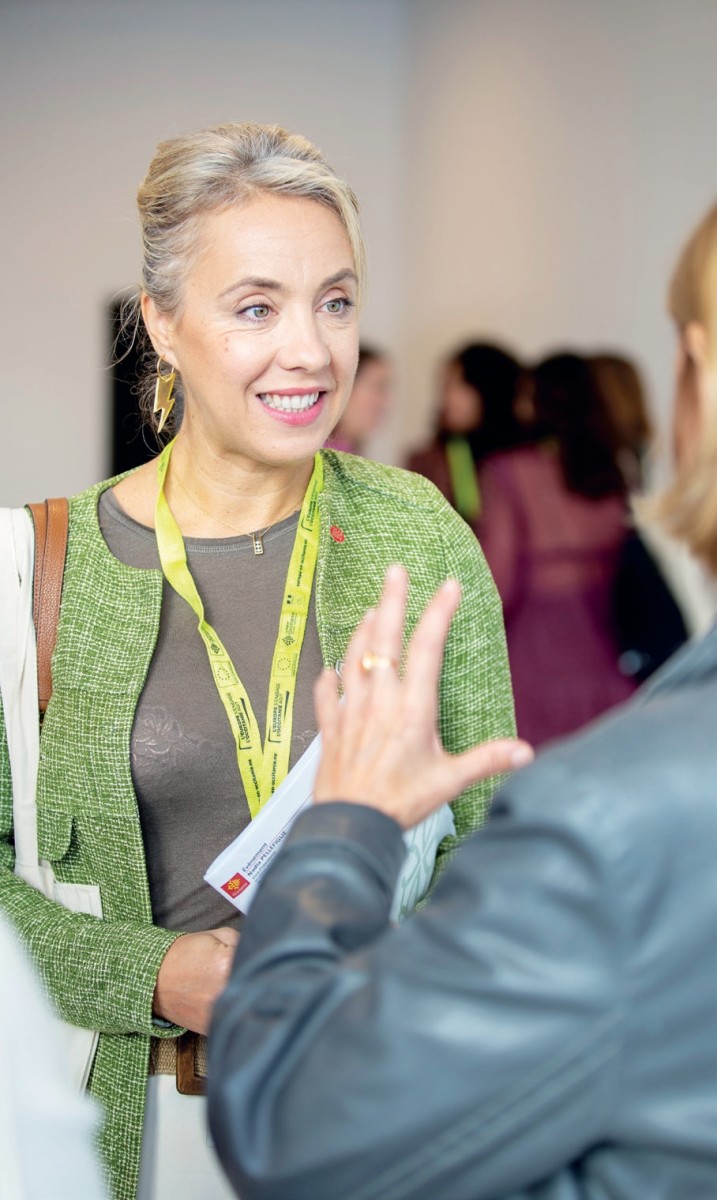
An interview with Mrs Nadia PELLEFIGUE, Vice-President of the Occitanie Pyrenees-Mediterranean Region in charge of Higher Education, Research, Europe and International Relations
Making Occitania one of the leading scientific and technological regions in Europe
What are the strong points of the regional ecosystem in terms of research and innovation?
Our first strength is the high number of students (270,000), researchers and higher education institutions (39). Public and private research represents 3.5% of the regional GDP, which makes Occitania the leading French region in terms of research intensity and constitutes an essential lever for innovation. Moreover, the Region is keen to strengthen the higher education and research network beyond the two metropolises, thanks to 18 balanced university towns (Perpignan, Nîmes, Albi, etc.) which are more welcoming to students from rural areas.
Could you present to us the main lines of the regional strategy for supporting research and innovation players?
As you know, the SRESRI (Regional plan for higher education, research and innovation) was the subject of a large-scale consultation and defined three major challenges. The first is to prepare the skills of tomorrow in a society in transition – skills that are essential for reducing our energy consumption and producing new energies such as green hydrogen. Our second challenge is to make Occitania one of the leading scientific and technological regions in Europe. This will be achieved through participation in European projects, collaboration between laboratories and companies, attracting international talent and increasing the mobility of researchers and students. Finally, the third challenge concerns student success with a pronounced support for student life (food, health, housing) and the creation of a dedicated working group to make students the actors of public policies concerning them.

What tools do you have to support innovative companies?
The Region offers development support tools and financial aid. The regional development agency, AD’OCC, supports VSEs and SMEs, which account for 93% of the region’s companies: finding the right laboratories to develop their products or solutions, raising awareness of the ecosystem and the culture of innovation, etc. All companies are capable of innovation. For example, Pillon, the famous Toulouse pastry shop, worked with Cnes to create an edible foam made from Genoa bread to wrap the instruments used for experiments on the ISS: a delicious way to save space in a cramped environment! In addition, the Region has I-Demo, a multi-annual (up to 3 years) research funding that covers 50% of the total budget. One of the projects supported concerned the replacement of palm oil in certain food products. The Region also supports the 9 competitiveness clusters on its territory, participates in the capital of the two SATTs, i.e. Technology Transfer Acceleration Companies (AxLR, Toulouse Tech Transfer) and has fully financed the CEA Tech building in Toulouse. Finally, let’s not forget the support for research contracts of the major organisations that have regional offices.
How are researchers and industrialists involved in implementing the Green Pact for Occitania and the «Plan for the power of living and energy sovereignty» as part of the RéPOS Positive Energy Strategy?
We have set two very ambitious targets to become France’s leading RéPOS region: to reduce our energy consumption by 40% and to triple our renewable energy production by 2050. To achieve this, we can count on our excellent positioning in terms of photovoltaic, hydroelectricity and offshore wind with the future commercial farms of Qair Group. We are also working with Schlumberger, based in Béziers, to develop green hydrogen production solutions. More broadly, the Region is supporting the most energy-intensive sectors, such as aviation, with a Plan for Sustainable Aviation. It is also financing €30 million of the €35 million needed to open a technocampus dedicated to green hydrogen on the Francazal site in 2025: 50% of the surface area will be used to accommodate 120 researchers, while the remaining 50% will enable manufacturers to test green hydrogen applications for mobility (train, plane and bicycle). Similarly, the Region supports initiatives in the construction sector, which accounts for 25% of CO2 emissions: materials, wood-energy, heating networks and inert concrete are all the focus of our attention. We have even organised a competition to stimulate research into high-rise wooden buildings. We also grant aid to companies to reduce their energy consumption, set up mega-factories or photovoltaic fields with the help of the AREC, the Regional Energy and Climate Agency. There is no shortage of projects!
Originally published in ©Parlementaires de France Magazine, now ©Research Innov France.
