
An interview with Mr. Nicolas VIALLET, Operational Director of 3IA ANITI and Mr. Nicholas ASHER, Scientific Director of 3IA ANITI
Hybrid AI for mobility and robotics
What are the key figures of 3IA ANITI?
Nicolas Viallet (N.V.). ANITI relies on nearly 110 researchers, 90 PhD students and post-doctoral fellows, around 30 engineers made available by our 30 industrial partners and around 20 academic partners. Since its launch in 2019, it has produced some 650 scientific publications, a third of which are in very high-level journals. In addition, 4,000 students have followed training courses in artificial intelligence (AI) labelled by us in 2021 (i.e. double the figure for 2018) and more than 100 companies have participated in our various dedicated events in 2022.
Nicholas Asher (N.A.). Beyond the numbers, ANITI has helped cross the barriers between disciplines: mathematics and computer science, complex physical models and AI, neuroscience and AI…

M. Nicholas Asher
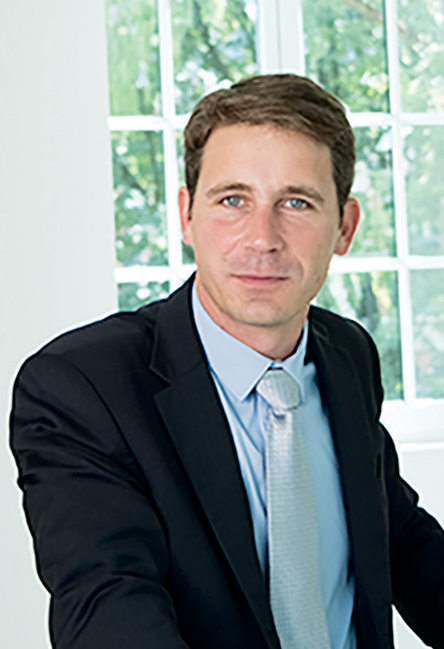
M. Nicolas Viallet
Could you present the strategic application sectors, the integrative programmes and the scientific chairs of ANITI?
N.A. Among the strategic application sectors studied in the 3IAs, ANITI has focused on two: smart mobility and industry 4.0. These areas are fuelled by fundamental research on explainability, robustness to perturbations in the data, management of data biases and the effectiveness of inductive reasoning in AI systems to optimise their many parameters and make them more efficient. Smart mobility also requires research on certification issues of AI in critical systems. But ANITI has chairs whose research concerns other strategic sectors. For example, a scientific chair is dedicated to remote sensing, a subject of major interest for the space industry but also for climate, agriculture and agronomy. In parallel, ANITI has 3 integrative programmes which focus on acceptable AI (for society and citizens), certifiable AI and collaborative AI.
N.V. These 3 programmes are intended to be complementary. The first one aims at studying the societal consequences of the use of AI, the second one deals with the implementation of AI in critical products or services (aeroplane, car, hospital…), and the third one is dedicated to the use of AI to optimize man/machine collaborative processes.
N.A. Fundamental research on mathematical optimisation tools and applied research on analytical models feed each other. Hybrid AI allows mathematical or physical knowledge to be injected into these models to make them wiser. This work is essential for certifiable AI and contributes to the development of guidelines by the European Aviation Safety Agency. Finally, collaborative AI focuses on human-robot interactions with work on motion science, linguistics, automatic language processing and computer or neuroscience-inspired vision. A scientific chair is dedicated to the design of new molecules from plastic waste molecules reduced to their primary components. The optimisation of processes by AI also applies to the planning of complex industrial systems to enable them to adapt to hazards, to detect possible anomalies, etc.
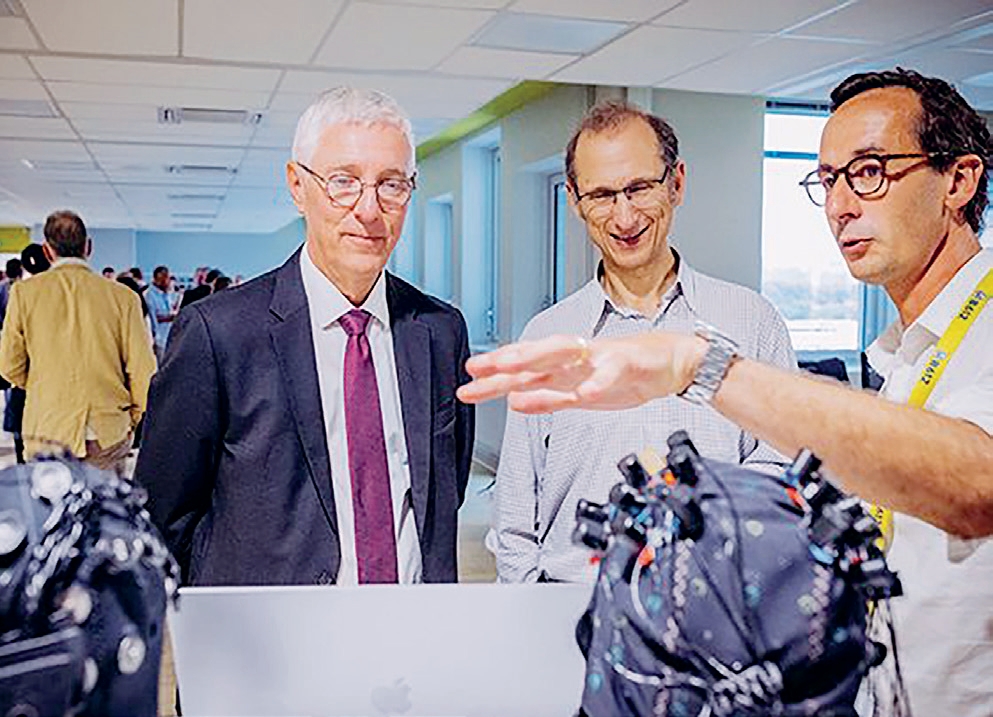
Inauguration evening for ANITI’s new premises in June 202
What partnerships have you developed?
N.A. ANITI is involved in the European partnership COALA which uses AI to improve factory construction processes through the detection and prediction of anomalies. A PoC has been achieved in this framework. Two other projects, COCOBOT focuses on the development of a cobot (conversational robot) while COCOPIL aims to design a multimodal model for an assistant robot in an industrial or commercial context (a partnership with the SME Linagora and Airbus).
N.V. This last project perfectly illustrates what we wish to develop within ANITI, a great interdisciplinary strength but also a capacity to make industrialists of different sizes and sectors work together. I would also like to mention the DEEL (DEpendable and Explainable Learning) project which brings together French and Quebec players in the aeronautics and mobility sectors who share the same challenges of certification of critical systems integrating AI.
In your opinion, what are the challenges to be met in order to advance hybrid AI?
N.A. The first, technological challenge is to create a hybrid AI that is more frugal, more data-efficient, more explainable and more robust, which will benefit from the application of AI in various fields and in our strategic application sectors.
N.V. Training is another major challenge to enable companies to grasp ANITI’s advances and transform them into real and concrete solutions. This human and organisational challenge is at the heart of the training component of phase 2 of the national strategy for AI. It is in this context that the 4 French 3IAs have launched the EFELIA initiative, which will enable the massification of AI training by pooling our pedagogical and methodological resources.
N.A. Beyond its primary symbolic dimension, hybrid AI integrates knowledge from various sciences (including humanities and social sciences) as well as machine learning and deep learning. This is a challenge and an asset for the training of future engineers and the industrialists who will recruit them. Our master’s degree in computer science and mathematics is already contributing to this.
N.V. This hybrid approach differs from all-machine learning approaches and corresponds well to the concrete problems faced by players in the application sectors to which the national strategy is addressed. In this sense, it can contribute to meeting the challenge of national economic sovereignty.
Originally published in ©Parlementaires de France Magazine, now ©Research Innov France.
