
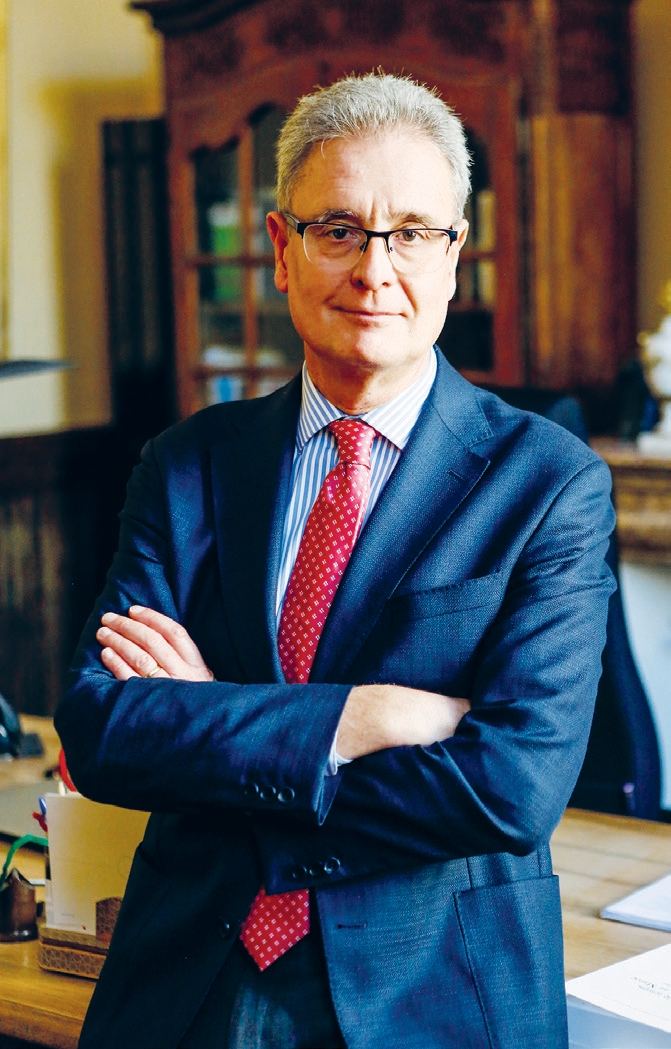
An interview with Prof. MEHDI, President of the Conférence Régionale des Grandes Écoles – PACA, Director of Sciences Po Aix
Facing together the major transitions linked to the economy, reindustrialisation and the environment
What are the areas of excellence among the members of the Conférence Régionale des Grandes Écoles – PACA (CRGE PACA)?
The CRGE PACA is part of a permanent development dynamic with 18 member schools, compared to 15 in 2020. Resolutely multidisciplinary (engineering sciences, business, political sciences, art and design, architecture…), it is identified as a credible resource of expertise and its members train “practitioners of complex systems” who will be able to apprehend the major societal challenges such as sustainable development, economic and ecological transitions, geopolitical and environmental risks, digital issues and artificial intelligence… But the grandes écoles do not only provide knowledge: they also transmit interpersonal skills, an ethic of responsibility and a taste for community service.
Could you give us some examples of research projects underway in member institutions?
KEDGE Business School has opened a humanitarian chair with the aim of setting up a certificate in humanitarian logistics in line with its scientific and educational policy. The École de l’Air de Salon de Provence is at the forefront of research into drones and AI (human-machine interaction in future combat). SKEMA Business School is developing a research project on the dismantling of nuclear infrastructures in collaboration with engineers and is working on health data management with the University of Nice. Two years ago, Sciences Po Aix joined forces with the Académie du renseignement to create a specialised master’s degree that will be integrated into a partnership chair whose main objective will be to promote the emergence of a French intelligence culture.

How do the actions of the CRGE PACA fit in with the site policies in the region?
Our main concern is to strengthen the level of inter-knowledge between the various players in the region. As the third largest player in regional higher education, with nearly 20,000 students, the CRGE PACA was involved in the work of drawing up the Regional Plan for Higher Education, Research and Innovation (SRESRI). In addition, Sciences Po Aix and Centrale Marseille are founding members of the IdEx Aix-Marseille University (AMU) and as such participate fully in the operation of the site. The CRGE PACA has also provided a privileged forum for exchange with the rectorate, the universities and the public authorities in order to face the pandemic ordeal by promoting certain pedagogical innovations such as the digital platforms, which have since become efficient digital campuses. Finally, the CRGE PACA encourages stronger partnerships between its members, such as the common path between Sciences Po Aix and the École de l’Air, the partnership on cybersecurity and the mutual hosting of students between Sciences Po Aix and Centrale Marseille… These initiatives contribute to the dynamism and influence of the region.
How is the CRGE PACA helping to meet the challenges of the changes in higher education and research?
We are organising a major event on 5 June 2023 to bring together our member schools and the major public and private players in the region. Our objective is to make ourselves better known and to clarify what we can offer the region. Our guiding principle: how can we face together the major transitions linked to the economy, reindustrialisation and environmental challenges? We can provide an answer through what makes our model unique: training in the practice and animation of complex systems by combining disciplinary skills, soft skills, leadership, creativity, open-mindedness to build bridges between different disciplines, historical and cultural perspective… In fine, the CRGE PACA bases its mission on three concerns: the relevance of the training to our objectives (training tomorrow’s public and private sector executives), innovation (developing teaching tools for an ever more effective transmission of knowledge) and the democratisation of access to higher education by reconciling openness and selectivity. For a long time, we have been working to create conditions of access for socially or economically vulnerable students and we are proud of our 30 to 35% of scholarship holders! Our members have also established partnerships with secondary schools located in REP (priority education networks) or REP+ to prepare their students for higher education. This policy has proved its worth: we certainly train an “elite” but without ever cultivating a caste mentality that we abhor. Our responsibility to society is at stake.
Originally published in ©Parlementaires de France Magazine, now ©Research Innov France.
