
An interview with Prof. Isabelle RYL, Vice-President of Artificial Intelligence at Université PSL, Director of PR[AI]RIE-PSAI
Training for AI acculturation
Could you tell us about PSL’s Paris School of AI programme?
First of all, PR[AI]RIE-PSAI is one of the 9 winning IA Clusters in the call for projects announced in June 2024. Led by Université PSL in partnership with Université Paris Cité, CNRS, Inria and Institut Pasteur, it is structured around three strands: research, training and innovation. The research component brings together 125 identified researchers who use AI to serve the sciences (mathematics, computer science, robotics, language processing, cognitive science, physics, statistics, health, astronomy, chemistry, materials science, etc.), the humanities (sociology, economics, philosophy, history of science, etc.) and the arts, with a strong focus on disseminating AI across all scientific disciplines. In terms of training, the Paris School of AI’s objective is to offer a very high-level public curriculum, in direct contact with the latest scientific innovations and at all levels from post-BAC to post-doctorate. As for innovation, it supports the transfer of research results to companies through the co-supervision of theses, bilateral research contracts and the creation of start-ups by students and researchers (PSL Pépite programme, PSL Innovation Fund, PUI, etc.). And let’s not forget our European collaborations (via the European ELLIS network and ERC grants) and international collaborations (with the United States and Asia).
Could you tell us about the training on offer at PR[AI]RIE-PSAI?
Before 2019, there were already masters degrees in mathematics and computer science specialising in AI, as well as continuing education courses. During its first four years of existence, PR[AI]RIE has had a catalytic effect within PSL, which has, for example, created a ‘data minor’, a cross-disciplinary programme that aims to acculturate students from all disciplines to AI. As a result, we are now able to offer a complete curriculum from bachelor’s degree to doctorate for specialists and non-specialists in both initial and continuing education.
What new courses are you offering in AI?
We have launched a new degree: a CPES (between the bachelor’s degree and the preparatory year) in “Data Sciences, Art and Culture”, as well as a double bachelor’s degree in “IA & Organisational Sciences” at Dauphine – PSL. At the start of the 2025 academic year, we will be proposing a reform of our “AI and Data Science” (IASD) master’s degree, with 2 courses in mathematics and computer science. A master’s degree in “AI and Society” and a new “International Bachelor of Science in AI” should attract a wider student body, as they will be taught in English. In addition, we are developing our continuing education offering through apprenticeships, an executive master and the development of ad hoc courses in conjunction with professional organisations. We have already trained the third class of project managers at the request of the Société des Ingénieurs de l’Automobile (SIA). Société Générale has also called on us (2 classes), and we are working with We Are in the cultural and creative industries.
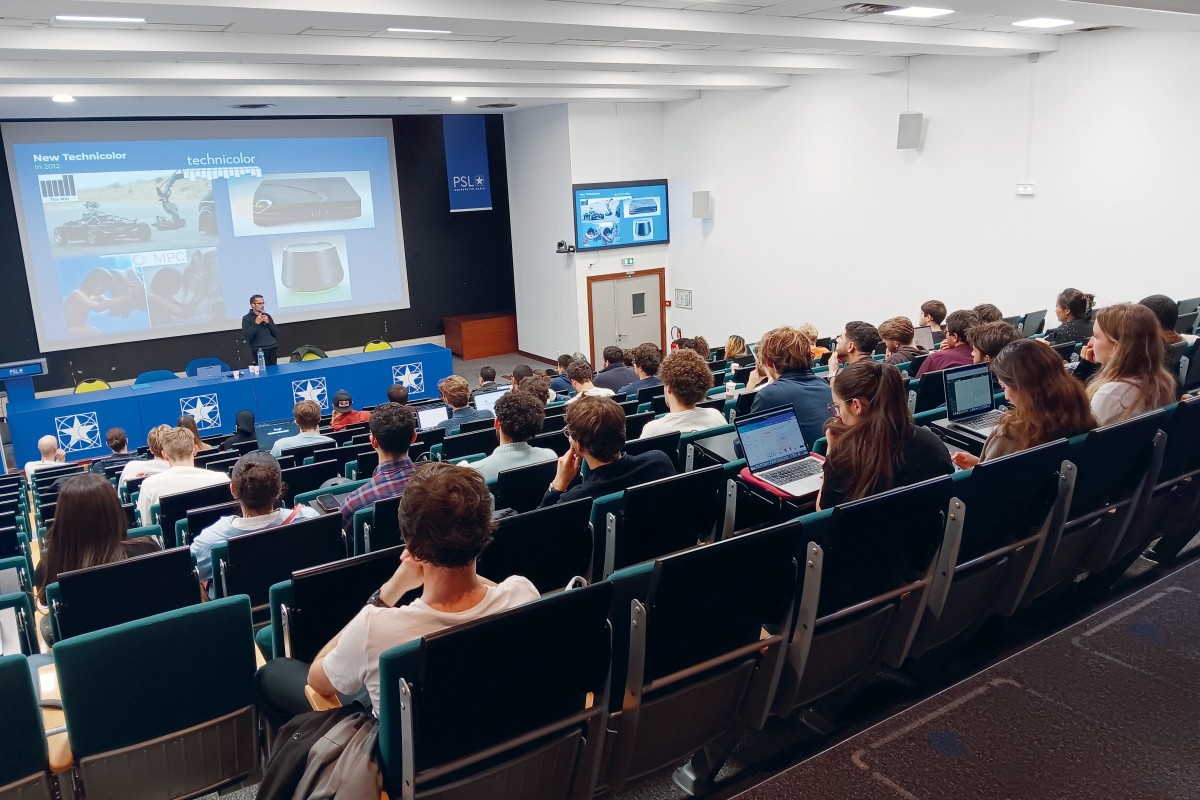
PSAI Evening Talks, November 11, 2024
What do you see as the main challenges in adapting training to the new professions requiring AI skills?
The need for AI training is immense. The idea is not to create AI specialists, but to help them understand the impact of AI, a statistical and mathematical tool that is profoundly changing practices in different specialities and professions. We are already thinking about training courses in AI applied to finance and insurance, to healthcare (with continuing education programmes for doctors supported by Paris Cité)… Ultimately, it is society as a whole that needs to become acculturated to AI. Starting with young people: in February 2025, in conjunction with the AI summit in Paris, we organised remote and on-site conferences for secondary school students (Entretiens d’Excellence, France Digitale) as well as workshops with specialists. These are all acts of mediation to make AI a part of everyday life and inspire young people to choose a career in science. Our presence on social networks, the “AI in the City” day organised by ENS-PSL during the AI summit mentioned above, and Dauphine – PSL’s “Ex Machina” podcasts, aimed at a wide audience, also help to disseminate AI knowledge for all.
Originally published in ©Parlementaires de France Magazine, now ©Research Innov France.
