
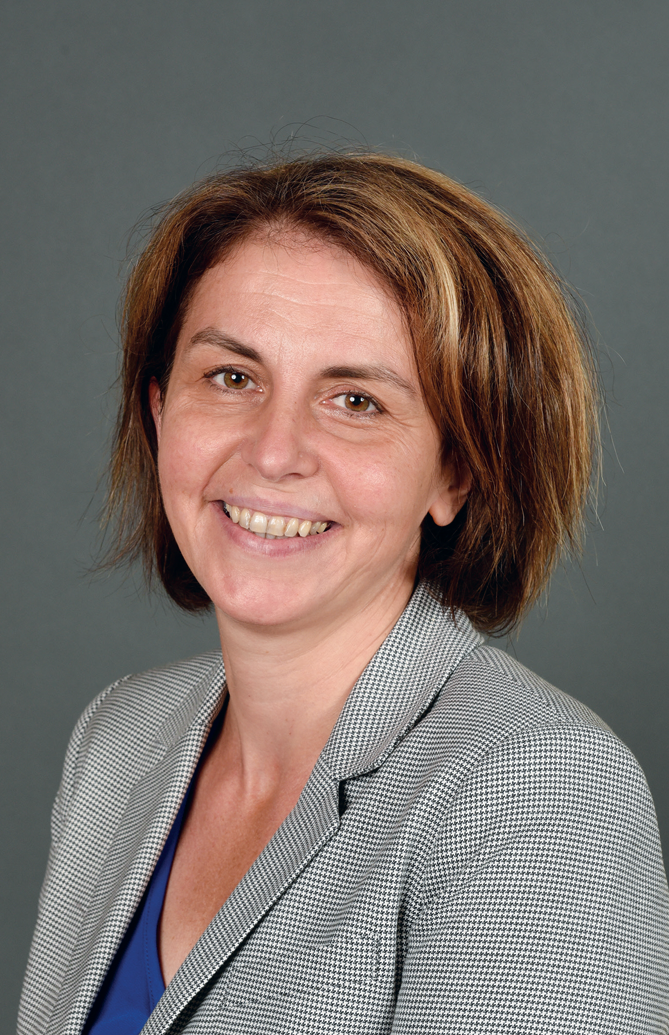
An interview with Mrs Julie BARENTON GUILLAS, Vice-President of the Normandy Region with responsibility for Higher Education, Research, Innovation, Digital Technologies and Health
Enhancing the value of industrial professions in the service of transition
What are the areas of scientific research excellence in Normandy?
Normandy has 6 areas of specialisation, which are breeding grounds for innovation and scientific excellence: agriculture, the energy mix, industry, mobility, health and “risk management”. Digital technology is another cross-disciplinary field in which our region boasts a wealth of talent. Normandy also has more than 100,000 students, 11,000 R&D jobs, 6,300 researchers and three universities, all prizewinners — and this is a first! — of the ExcellenceS call for projects: Caen, to strengthen the excellence of its research in neurosciences, materials sciences, nuclear physics and digital innovation for social sciences and humanities; Rouen, to enhance its expertise in risk management; and Le Havre, to strengthen the logistics, maritime and port dimensions of its territory. Normandy also boasts major research infrastructures such as the GANIL (Grand Accélérateur National d’Ions Lourds), the MRSH (Maison Régionale des Sciences Humaines), the university hospitals of Caen and Rouen, the François Baclesse cancer centre in Caen and the Henri Becquerel cancer centre in Rouen, the CYCERON biomedical imaging platform, the ARCHADE hadrontherapy centre in Caen, the CRIANN (Centre Régional Informatique et d’Applications Numériques de Normandie), etc. All of this is linked to the region’s competitiveness clusters: aeronautics and automotive, energy, digital, maritime and port industries, chemicals and health, nuclear, logistics, construction and the equine sector.
How is the Normandy Region supporting those involved in research and innovation?
The new SRESRI (schéma régional enseignement supérieur recherche innovation), approved by the Regional Council at the end of 2022, has resulted in strategic partnership agreements with institutions whose attractiveness we want to increase through three schemes: Normandie Sup’ for higher education (international initiatives, dissemination of scientific, technical and industrial culture, training, guidance, etc.), Normandie Recherche (laboratories with platforms and infrastructures, chairs of excellence, doctoral grants (around a hundred each year), emerging projects or candidates for international competitive calls for projects), and Normandie Innovation (collaborative projects between academic establishments and businesses, pre-maturation and maturation of projects via Normandie Valorisation, creation of start-ups via Normandie Incubation).
How do you support research into human and animal health?
Normandy is home to many cutting-edge players in cancer research, biomedical imaging, the development and production of drugs and medical devices, and equine health. In neuroscience, we have supported the CYCERON centre’s projects on post-traumatic stress (13 November – Remember programme), memory (CIRAANO) and Alzheimer’s disease (PleiAD). In oncology, we are supporting the Genomics Institute project on the Rouen Health Campus and the ORGAPRED platform (production of tumour organoids to predict response to treatment and for research purposes). In equine health, we support the AVEQ-ACTIVE project (combating viral infections affecting equidae), the Translational Antiviral Strategies Chair of excellence (developing and validating innovative diagnostic tools and treatments for human and equine viral infections) and the IMAGE-TREAT platform (treatment and rehabilitation of equine arthropathies and tendinopathies). As part of its regional health strategy, the Region is keeping a close eye on jobs in short supply, and has intervened to encourage the opening of odontology faculties in Normandy. Lastly, it is supporting the Campus Equin project at Goustranville, which will house the equine health teaching and research activities of the Ecole nationale vétérinaire d’Alfort (EnvA) in Normandy.
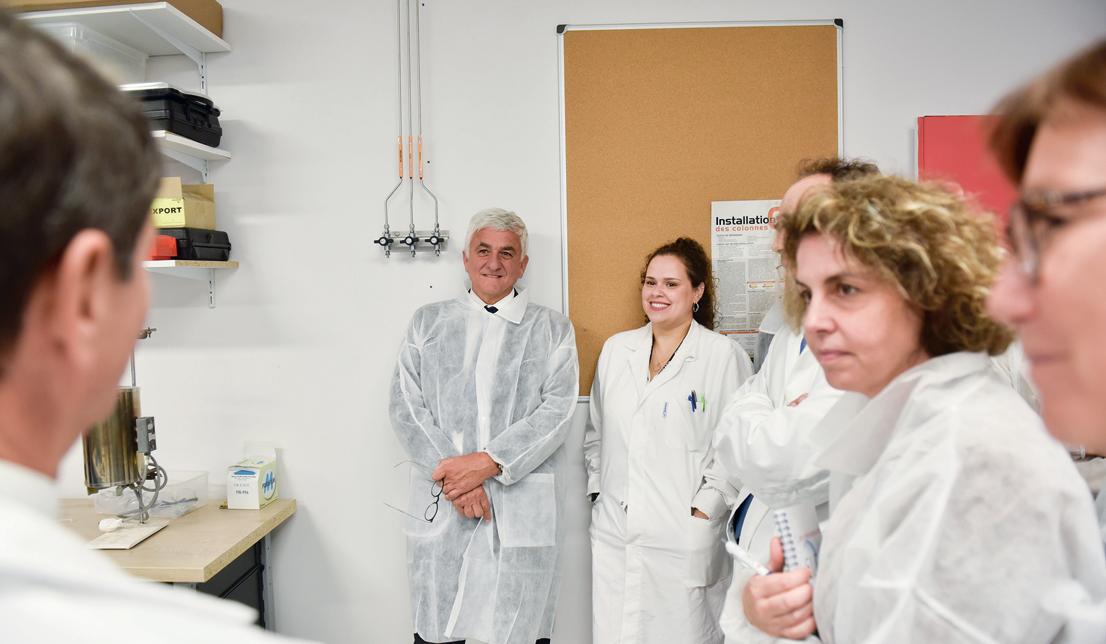
Julie Barenton Guillas and Hervé Morin visited
the Catalysis & Spectrochemistry Laboratory in Caen on 17 October 2022
What is your assessment of the digital and industrial transitions underway?
Normandy has managed to maintain a large proportion of its industrial activity in the automotive, aerospace, nuclear energy, chemicals and pharmaceuticals, mobility and agri-food sectors. The ongoing transformation of the industrial base means that research and innovation must be mobilised to develop new processes (digitalisation, new materials, social responsibility, energy transition, etc.). With this in mind, the Region is funding the construction of a new data storage centre for research establishments, a new supercomputer and a regional data lab. It has also joined forces with Normandy’s universities to respond to the CMA (compétences et métiers d’avenir) call for expressions of interest, is supporting the Normandy polymer additive manufacturing platform (2023-2026) and is promoting the attractiveness of industrial professions. With drones and Industry 4.0 as our showcase!
Originally published in ©Parlementaires de France Magazine, now ©Research Innov France.
