The only star research facility in Normandy, GANIL relies on its 300 members to host between 200 and 400 international researchers each year, who benefit from the facilities to carry out their experiments, as do the 85 current PhD students.
GANIL – Large National Heavy Ion Accelerator
An economic interest grouping bringing together the CNRS (IN2P3) and the CEA (DRF), GANIL has more than 3,000 scientific publications to its name and celebrated its 40th anniversary in 2023. It’s a great story that began with 4 cyclotrons, beams of ions sent to a dozen experimental rooms equipped with spectrometers with performances that are unique in the world. Then came SPIRAL, a radioactive ion accelerator, followed by SPIRAL 2, a very high-intensity ion accelerator with new experimental rooms: NFS for new neutron-induced science, and S3 for research into superheavy radioelements and rare isotopes. Lastly, the DESIR room building site was inaugurated: its instrumentation will receive the ion beams from SPIRAL 2 and the rare beams from SPIRAL 1.
GANIL has strong international collaborations, and has hosted major projects such as AGATA, which brought together nearly 200 European researchers over a long 7-year campaign to study exotic (radioactive) nuclei. A number of IN2P3 and CEA laboratories are actively contributing to the development of GANIL’s instrumentation, including the LPC in Caen. New collaborations are emerging at regional level with the CYCERON laboratory and Caen University Hospital to produce innovative radioisotopes for nuclear medicine.
In terms of training, nearly 50 trainees are welcomed on site each year, and around twenty GANIL members provide nearly 300 hours of teaching a year in secondary schools, universities and vocational training centres. Through the new Prof@GANIL initiative, GANIL will be welcoming 20 teachers for a week of immersive theoretical teaching and practical work for their pupils. Another participatory science initiative supported by the Normandy Region is the experimentation by secondary school students of science cases using its accelerators. It’s a great initiative for this extraordinary facility, which is determined to advance fundamental research in nuclear physics, astrophysics and astrochemistry, as well as more applied research for the space, nuclear and health industries.
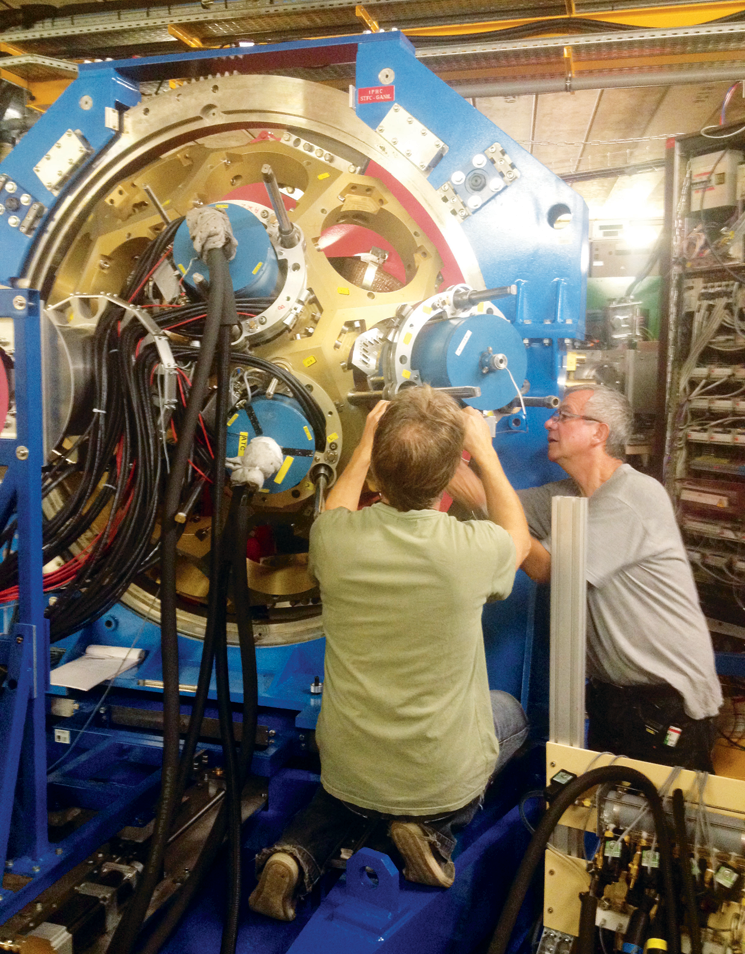
Preparing a nuclear physics experiment with the AGATA detector
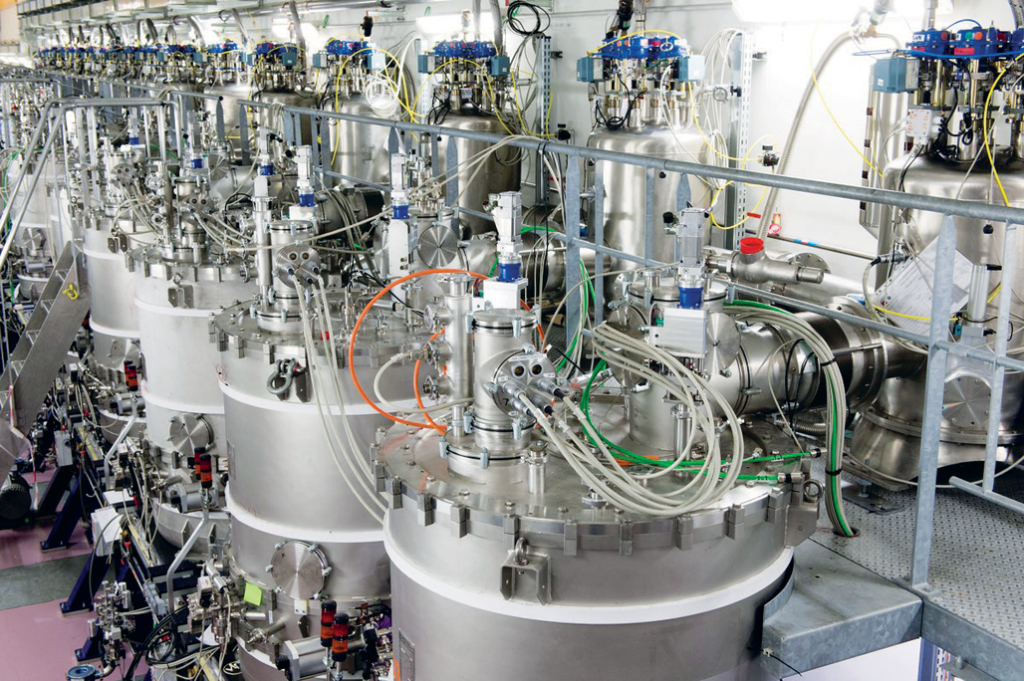
Cryomodules of the SPIRAL2 superconducting linear accelerator

GANIL – Grand Accélérateur National d’Ions Lourds
Bd Henri Becquerel – BP 55027 – B-14076 Caen Cedex 05
Tel. : +33 (0)2 31 45 46 47
https://www.ganil-spiral2.eu
Originally published in ©Parlementaires de France Magazine, now ©Research Innov France.
