
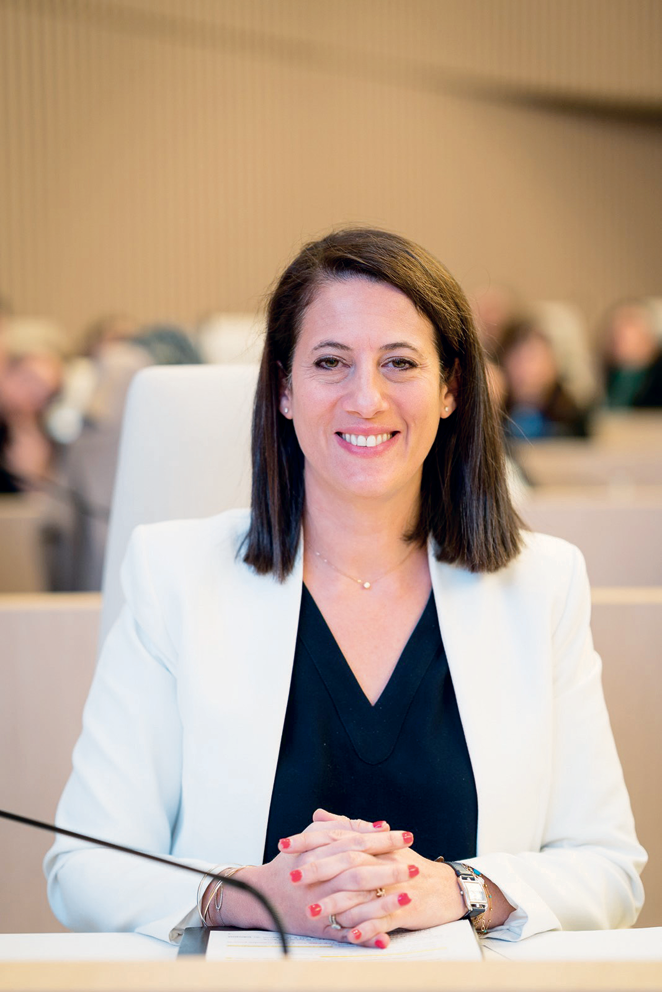
An interview with Mrs Alexandra DUBLANCHE, Vice-President of the Île-de-France Region, responsible for Recovery, Attractiveness, Economic Development and Innovation
Helping to solve major challenges through our capacity for innovation
Could you outline the key points of the SRDEII 2022-2028 “Impact 2028”, which serves as the region’s S3?
Through this economic strategy, the Region has set itself the objective of reconciling high environmental standards with economic development, while building the means to ensure the resilience of the Paris Region economy. The aim is to consolidate our position as a major player in international competition, while at the same time using our capacity for innovation to contribute to solving major challenges and promoting the ambition of a low-carbon economy in the Paris Region. With “Impact 2028”, the Region’s ambition is to unite all the players in the region around the values of cooperation and competition in the service of economic development. Finally, we are concentrating our initiatives on sectors and areas of strategic interest to structure ecosystems and make them resilient and competitive at global level. For example, we have chosen 6 strategic areas that will shape the world of tomorrow and over which we must have sovereignty in France and Europe: AI and HPC (high performance computing), quantum, materials and cleantech, hydrogen, bioproduction, biotechnologies and health technologies. Paris Region is the only global metropolis in Europe capable of providing this technological leadership.
What are the main regional innovation support schemes?
Upstream, the Île-de-France Region is helping to stimulate creativity and excellence in research, improve living and studying conditions for students and researchers, modernise facilities and campuses and promote links between research, technology transfer, innovation and economic development in order to put science and technology at the service of the common good. In 2024, the regional budget for higher education, research and innovation will total more than €400m. The flagship schemes include support for Major Research and Innovation Areas (DIM), funded for 5 years, and Questions d’Intérêt Majeur (Issues of major interest – QIM), with a strong interdisciplinary dimension. Over the period 2021-2026, the Region is providing more than €100m to help research laboratories in the Paris Region acquire the best scientific and technological equipment, through the SESAME and SESAME Filières France 2030 support programmes, the equipment section of the 2021-2027 CPER, as well as through the DIM, QIM and Genopole. This year, the Region will exceptionally be mobilising an additional €16m from the ERDF, earmarked for the development of platforms in our region, with the launch of the SESAME ERDF call for projects. Further downstream, the Region is supporting companies via the AI Challenges and Quantum QAPs, with a view to developing partnerships and deploying innovative solutions led by Paris Region business nuggets in our strategic sectors. Finally, with a €400m plan dedicated to low-carbon reindustrialisation over the next five years and almost 30,000 hectares dedicated to productive sovereignty in the Paris Region, the Île-de-France Region has a strong ambition to support disruptive technologies. A single regional sovereign wealth fund dedicated to private equity is to be launched, with the aim of raising nearly €250m in financing. It will be made up of three “pockets”: SSE companies, the decarbonisation challenges facing Paris Region SMEs and industrial start-ups.
What is the Prix des Innovateurs d’Île-de-France? Could you tell us about the winners of the last edition?
Created in 2020 by the Île-de-France Region, the Prix des Innovateurs aims to encourage, support and promote research, technology transfer and the emergence of innovations in the field of healthcare. In 2023, the 3 prize-winners stood out for the scientific excellence of their research and their ability to promote it. The 1st prize was won by Annarita Miccio, Inserm research director at the Imagine Institute, for her work on the regulation of the globin gene. With her team, she has developed a new treatment for beta haemoglobinopathies, diseases caused by mutations affecting adult haemoglobin. The 2nd prize was won by Olivier Couture, CNRS Research Director in the Biomedical Imaging Laboratory at Sorbonne University, for his work on improving care for stroke victims by developing a portable imaging device for emergency brain angiography in the ambulance. Julien Nicolas, CNRS research director at the University of Paris-Saclay, was the 3rd prizewinner for his work in the field of cancer treatment, with the development of a device for administering chemotherapy subcutaneously – a less costly and less restrictive protocol for the patient. A total of 12 researchers, including 5 women, have received awards since the Prize was created in 2020.
Originally published in ©Parlementaires de France Magazine, now ©Research Innov France.
