
An interview with vice-admiral d’escadre (2S) Arnaud COUSTILLIÈRE, Chairman of the Cyber Centre of Excellence (PEC)
For an autonomous cyber defence
Could you remind us of the PEC’s mission and key figures?
The cluster was created in 2014 in response to the 2008 White Paper on Defence and National Security. An industrial cluster based on dual technology, the PEC takes account of the new defensive and offensive battlespace that digital technology represents. It relies on a dynamic Breton ecosystem (DGA centre of expertise, COMCYBER, SMEs active in hacking, crypto, disinformation, universities, Télécom Bretagne, etc.), linked to the region’s development priorities: maritime, agri-food and cyber. Today, the PEC has nearly 130 members: the Ministry of the Armed Forces, start-ups, Inria, CNRS, around forty schools and faculties, major companies (EDF, La Poste, Capgemini, Thales, Airbus, Orange, Sopra Steria, etc.), SMEs (40% of which are Breton), an incubator, the Cyber Defense Factory, etc.

Could you tell us about your 3 strategic priorities?
The first area is research. Together with David Alis, Vice-President of the PEC and President of the University of Rennes, the Sequoia project (Cyber and AI) won the France 2030 call for AI & Cyber projects. In addition, the cluster leads around thirty working groups, in particular on Canada (with various universities in Quebec and the University of Rennes), quantum (with the organisation of the CAID – Conference on Artificial Intelligence for Defence as part of European Cyber Week)… Second area: training. As part of the ‘CyberSkills4All’ call for projects, the Cyber Centre of Excellence is providing strategic advice and putting companies with training needs and trainers in touch with each other. Around twenty organisations will benefit from France 2030 funding to raise awareness of cyber security among 80,000 schoolchildren in Rennes and train professionals. Finally, the third axis is focused on business, with discussion forums to relay calls for projects and investment opportunities, a working group on calls for projects from the European Defence Fund, participation in various events (Govware in Singapore, SIT Africa Forum in Marrakech, etc.), the opening of representative offices in Singapore, South Korea and Canada, the signing of a cooperation protocol with the Canadian cybersecurity association In-Sec-M, development aid, etc.
What do the ECP programmes consist of?
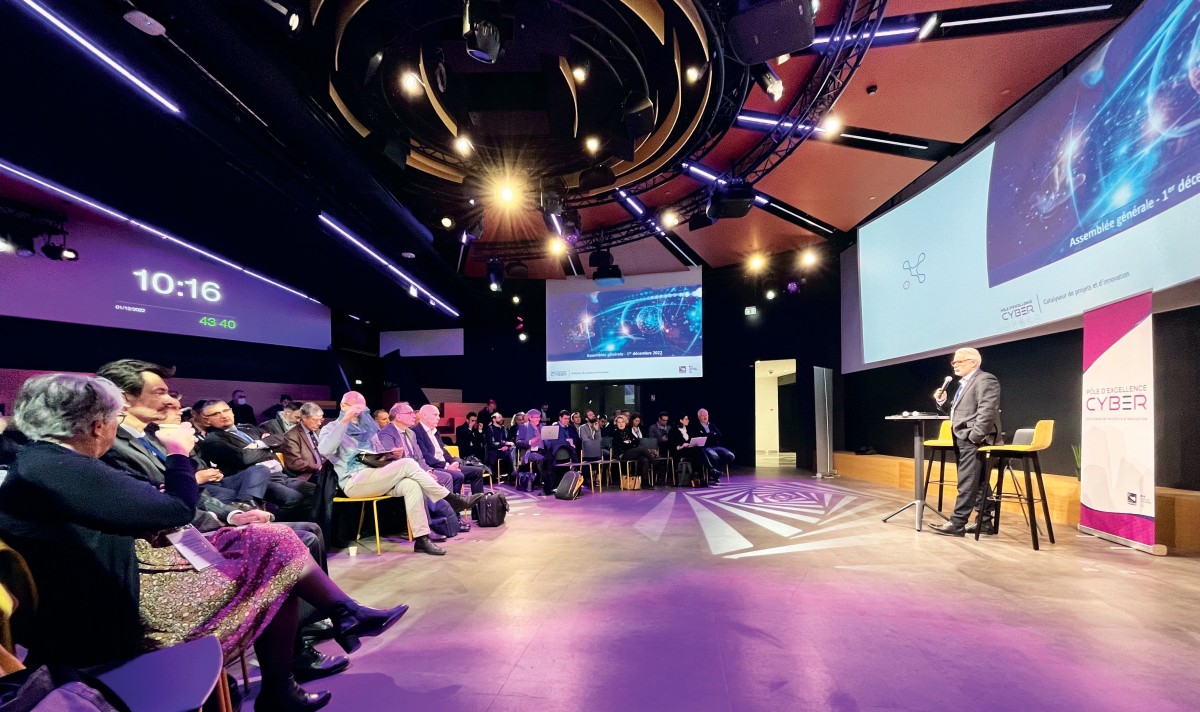
I’d like to emphasise the social and inclusive dimension of programmes like the Cadettes de la cyber: each year (we’re in the 5th year), just over a dozen young women at Masters level are selected, mentored and trained in the soft skills that will make all the difference to their careers. They raise awareness of cyber risks among secondary school pupils and are very active on the Internet, LinkedIn, Instagram, and the podcast La matrice a buggé (The Matrix Has Bugged Out). Taking a broader approach to the societal challenges facing the sector, the PEC also supports the inclusion of neuroatypical people in the workplace. Today, only 11% of people with Asperger’s syndrome are in employment, despite their recognised and sought-after skills. We favour high-profile micro-projects and would like to support around fifteen people in their thirties by 2025-26: the aim is to encourage companies to take up this initiative. In the wake of previous White Papers (integrating cyber risk into the local protection plan for small local authorities, combating the manipulation of information, etc.) and the Digital Security Guide for small and medium-sized local authorities, we are publishing a White Paper in May 2025 on the theme of trusted AI in the government sector. The PEC is also taking part in EDIH Bretagne, a programme that brings together 27 partners to support the cyber-resilience of local authorities and businesses. And let’s not forget our annual event: European Cyber Week (ECW), which took place from 17 to 20 November. This year’s edition confirmed ECW’s role as a key event for the French and European cyber ecosystem. The work focused both on the structural challenges of cybersecurity and on the development of trusted artificial intelligence applied to defence, which is at the heart of national sovereignty and security concerns.
What is your assessment of the PEC’s ten years of activity and what challenges do you foresee for the next ten years?
The PEC is already a success because it has supported the joint MinArm-Brittany dynamic, with the visible results being 10,000 jobs created in Brittany, 130 members and publications that enjoy a high profile. Our role was reaffirmed by a recent agreement between the Minister and the President of the Region. But we are acting from Brittany with a national objective with a European dimension. We are also very close to the Occitanie region. Our objective remains to satisfy our members and help them create an autonomous cyberdefence whose technologies will take the world by storm, thanks to entrepreneurs capable of taking risks. In an uncertain world marked by a high level of dependence on the outside world, there is an urgent need to develop strategic autonomy in a context where the desire for greater control poses a threat to data processing. Generative AI, quantum, 5G… Digital technology is at the heart of this technological transformation, and the PEC is playing its part
Originally published in ©Parlementaires de France Magazine, now ©Research Innov France.
