
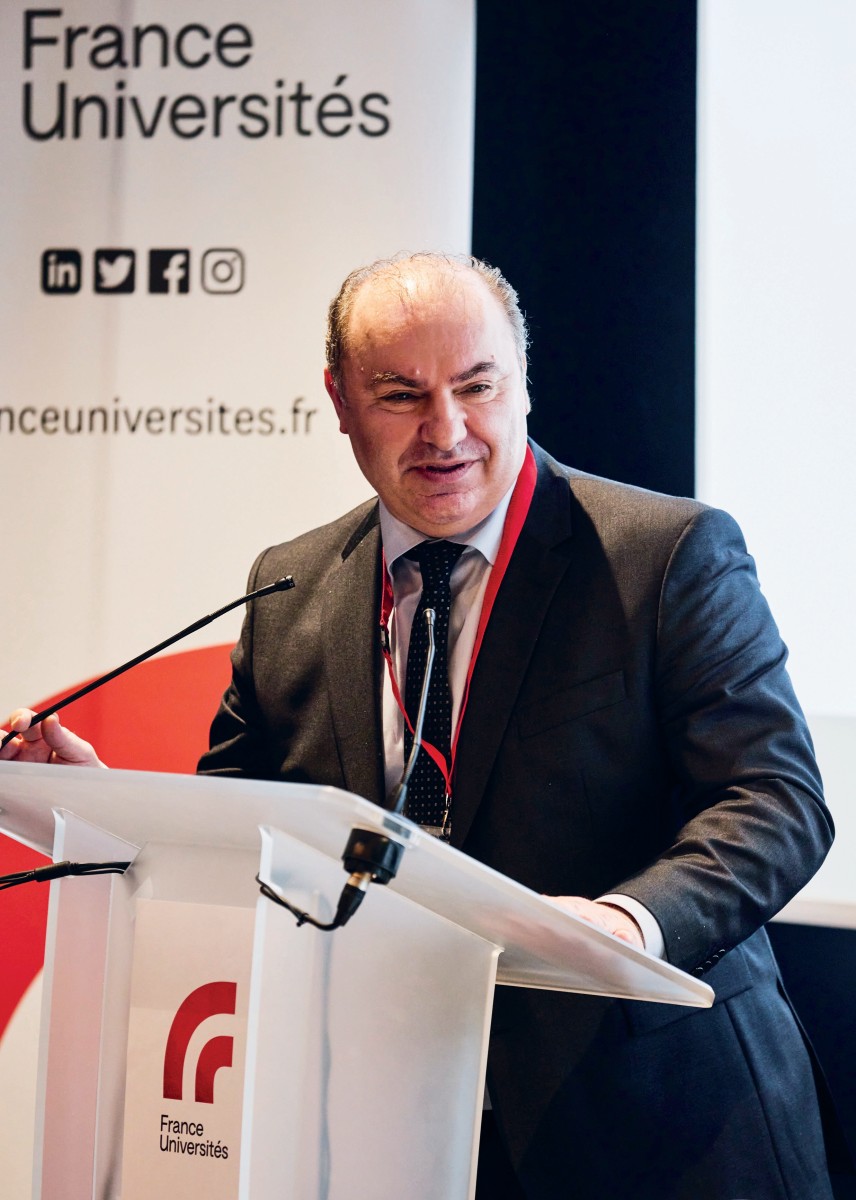
An interview with Mr. Lamri ADOUI, President of France Universités, President of the University of Caen Normandie
Open research, the key to tomorrow’s breakthrough innovations
Could you remind us what distinguishes universities in terms of research?
Universities are institutions at the heart of their ecosystems, working closely with all their partners: the State; local authorities, for whom research and innovation are a factor in attractiveness and economic development; the business world, with its needs in terms of training and skills; and civil society, which needs to be made more aware of science through a variety of events such as ‘My thesis in 180 seconds’. Thanks to the high potential of their research laboratories, universities are uniquely able to combine the challenges of education, research and innovation within their own structures. This is particularly true in the case of AI: training specialists, educating professionals, training trainers, high-level research, innovation, technology transfer… it’s a whole continuum that only universities can master.
Where does France stand as a scientific nation?
France is the fourth most awarded country in terms of Nobel Prizes (82) and second in terms of Fields Medals. It has more than 3,000 research laboratories and 55,000 researchers, and ranks second in Europe for patent applications, behind Germany but ahead of the UK and Italy. That said, a number of recent European reports point to France falling slightly behind the United States, China, South Korea and Singapore in terms of innovation. What’s more, the proportion of GDP devoted to research in France (2.2%) is still a long way off the 3% target set by the French government 20 years ago, and below the OECD average (2.7%). It is therefore important, at both French and European level, to step up efforts in the field of research and innovation, while providing fair support for directed, top-down research and free research, driven by the curiosity of the researcher and likely to generate breakthrough innovations for tomorrow. I would also like to highlight the entrepreneurial potential of universities, with no fewer than 6,000 student entrepreneurs in 2023-2024.
How are universities contributing to ecological and societal transitions?
Universities have significantly increased their skills and awareness of the ecological transition. In the wake of the 2022 Plan climat-biodiversité et transition écologique de l’Enseignement supérieur et de la Recherche, they have stepped up the production of new knowledge, the development of expertise and awareness-raising initiatives. 80% of universities have a member of their management team dedicated to these issues, and each university must finalise its sustainable development and social and environmental responsibility master plan by the end of 2025. In addition, a national training plan stipulates that by the start of the new academic year in 2025, 100% of undergraduates must receive training in sustainable development, and instructors must be trained for this purpose. The work of researchers and the PEPRs (including the one supported by the Université Gustave Eiffel on the city and sustainable building) are also playing a driving role. Another key factor is the university property portfolio, which represents a quarter of the State’s total, with over 10 million m². We are currently working with the European Investment Bank to facilitate recourse to borrowing and accelerate the implementation of energy transition projects that will enable us to reduce costs. After the Campus Plan and the France Relance plan, we are calling for a new long-term plan with the support of the State. On the societal front, universities are promoting science with and for society through a number of initiatives (ANR programme on participatory research, IUF contribution through researcher mediators and masters courses, events in local areas, etc.).
What obstacles do universities have to overcome in order to carry out these missions?
They are suffering from a serious lack of resources to carry out all their public service missions. Unexpected decisions by the State, such as the increase in the index point for civil servants without budgetary compensation, have a negative impact on their capacity for strategic management. Since the 2010s, universities have taken on 500,000 extra students without any additional funding. Yet universities have a key role to play in the major issues of skills and training, the future of young people, sovereignty and competitiveness. But they need to be given the resources to do so, in synergy with all the other players. These resources also concern the role of leader in higher education that the State assigns to the universities in their territories. I also wonder about the economic model for calls for projects, whose resources are not sustainable. Finally, I am concerned about the lack of institutional recognition of universities and, even more so, the lack of recognition of French doctoral students and the lack of bridges between the public and private sectors.
Originally published in ©Parlementaires de France Magazine, now ©Research Innov France.
