
Interview with Mr Bruno SPORTISSE, Chairman and Chief Executive Officer of Inria
Health, a field where AI has the most promising applications
Could you introduce us to Inria’s ecosystem?
Inria is the national institute for digital science and technology. Our 9 research centres are anchored in major university campuses, at the heart of corporate and startup ecosystems. Our 200 project-teams, small groups of scientists created for 4 years, usually in partnership, make up the dynamics of the institute. Their activity covers all fields of the digital world: from the digital heart to health, a priority for 20% of the project teams. Inria is a real ecosystem.
Inria participated in the creation of PariSanté Campus in December. Could you tell us more about it?
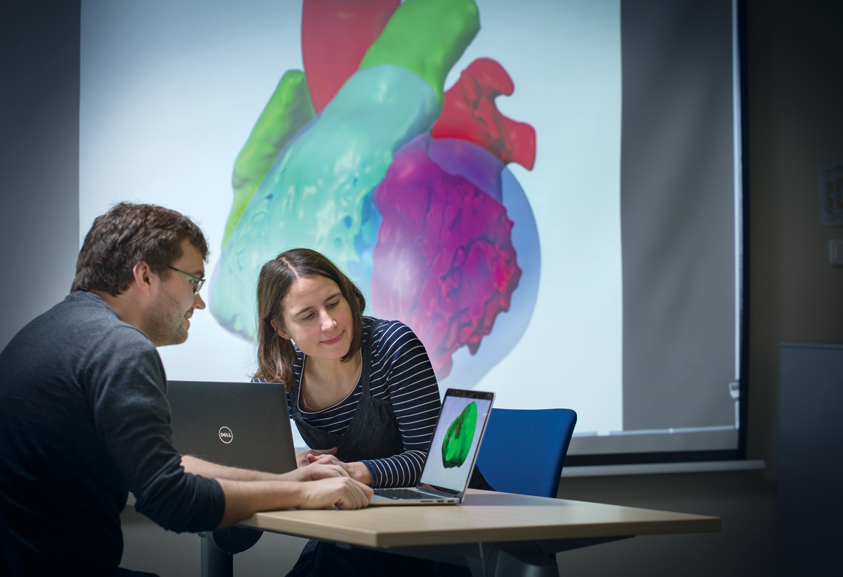
Segmentation of a human heart
Making France a world leader in digital health is a priority of Inria’s Contract of Objectives and Performance (2019-2023), signed with our supervisory Ministers, Frédérique Vidal and Cédric O. This can only be done in partnership: with INSERM, with university partners, the hospital world, the Ministry of Solidarity and Health, and the Health Data Hub, of which we are a co-founder.
PariSanté Campus is a joint initiative with INSERM, PSL (Paris Sciences & Lettres) and the Health Data Hub, including the APHP. It will enable us to accelerate the digital transformation of health by co-locating training, research, and innovation activities. This ambitious initiative, launched by the President of the Republic in December, will structure our action.
Could you give us some examples of research conducted by Inria’s project teams in the field of health?
Diagnostic assistance, personalized treatments, screening of molecules, simulation of surgical procedures: at Inria, interdisciplinary research projects also help to generate start-ups, such as Therapixel. We also focus on ethical concerns and the protection of health data (“privacy”).
Health is a field where artificial intelligence—the ability to use algorithms to make data predictive—has the most promising applications. Questions of sovereignty associated with the data economy are raised: it is key that France masters all the skills. This is Inria’s role: to enable this rise in digital maturity.
How did Inria mobilize its expertise in the context of the health crisis linked to Covid-19?
As early as March 21, 2020, we set up the Inria Covid-19 Mission. It supported more than 40 projects with clinicians and epidemiologists to provide operational solutions: monitoring resuscitation beds, web platforms for families, and analyzing combined health data (clinical, biological, scanners) to predict virus severity.
Inria was also commissioned by the Prime Minister to develop the StopCovid application (now TousAntiCovid), leading a public-private consortium. After the deployment, Inria became an assistant to the project manager at the Directorate General for Health. This was a first for the institute and a key part of the global crisis management strategy.
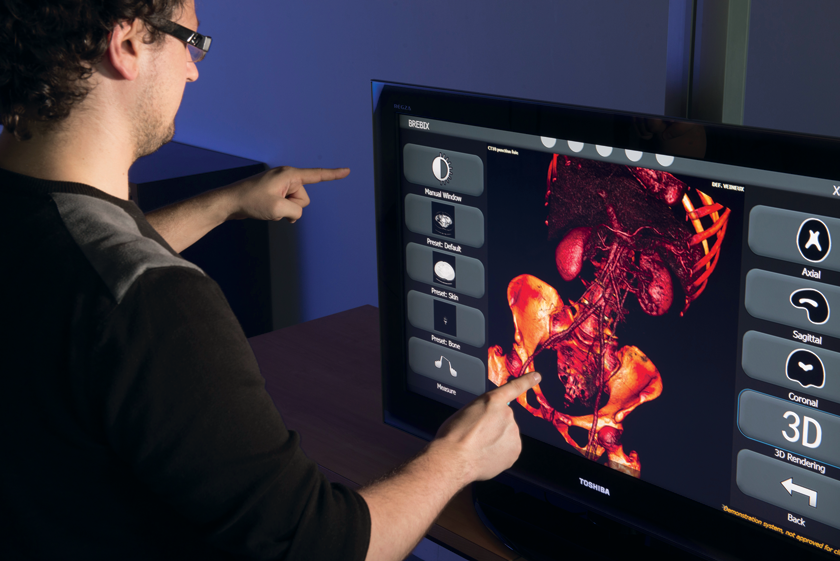
Therapixel: solution for non-contact visualisation and control of medical images in the operating theatre

Statistics applied to health
What do you see as the main challenges ahead in terms of algorithm regulation and the contribution of AI to medical innovation?
The growing role of algorithms raises fundamental questions about fairness and control. One answer is the regulation of digital platforms, a subject addressed by Thierry Breton in Brussels.
At the French level, we initiated REGALIA, a software toolbox for regulatory authorities. The aim is to make the regulator’s task easier. This approach is intended to be extended to AI algorithms used in the health sector to ensure “trusted AI” in all areas.
Originally published in ©Parlementaires de France Magazine, now ©Research Innov France.
